Why Your Rectangle Needs Different Rules
Contents
- Why Your Rectangle Needs Different Rules
- The Rule of Thirds (Your New Best Friend)
- Create Clusters, Not Scatter Patterns
- Ground Your Design With a Foundation Piece
- Play With Height Like a Stylist
- Mix Materials Like You’re Making a Recipe
- Stack Books With Purpose
- Repeat Colors For Cohesion
- Bring In Something Living
- Balance Pretty With Practical
- The Power of Empty Space
That elongated shape changes everything.
Square tables let you center things and call it done. Round tables forgive almost any arrangement. But rectangles? They expose every styling mistake with brutal honesty.
Place something dead center and it looks awkward. Spread items evenly and you’ve created a boring museum display. Pile everything at one end and the table looks lopsided.
The solution lies in understanding how our eyes process rectangular spaces.

The Rule of Thirds (Your New Best Friend)
Picture your table divided into three equal sections lengthwise. This mental grid becomes your foundation for everything that follows.
Here’s how to use it:
- Position major decorative elements at the two outer sections
- Keep the center third mostly clear for daily use
- This creates natural balance without feeling formulaic
I learned this the hard way after months of centering a decorative tray and wondering why it looked so awkward. The moment I shifted it to one-third of the way in, everything clicked.
Create Clusters, Not Scatter Patterns
Random placement screams “I gave up halfway through.” Instead, group items into intentional clusters.
The two-cluster approach:
- Position one grouping at each end of your table.
- This leaves breathing room in the middle.
- Your coffee cup finally has somewhere to land.
The three-to-five cluster method:
- Works better for longer tables.
- Creates more visual interest.
- Requires more items and careful balance.
I prefer the two-cluster approach because it’s harder to mess up and easier to maintain when you’re actually living with the table.
Ground Your Design With a Foundation Piece
Every strong arrangement needs an anchor.
Your options:
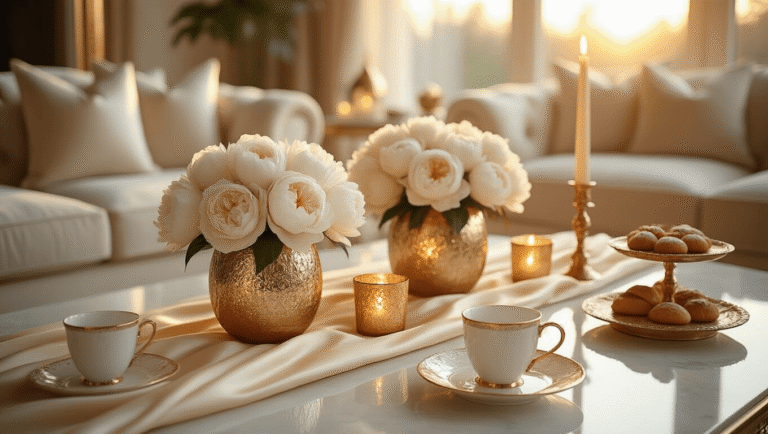
- Table runner: Softens the hard edges and creates a defined styling zone
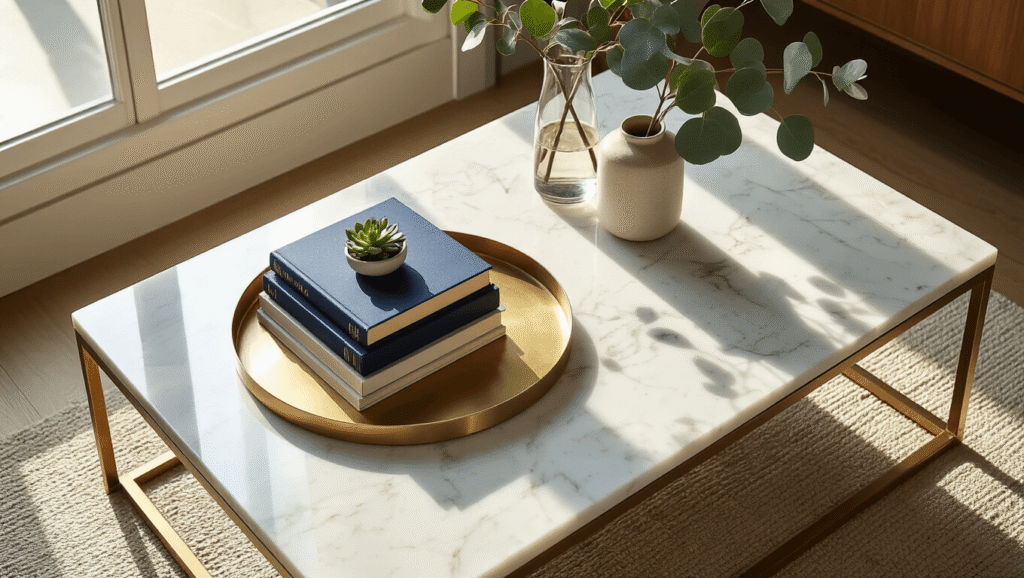
- Round tray: Creates gorgeous contrast against rectangular lines
- Rectangular tray: Reinforces the table’s geometry in a sophisticated way
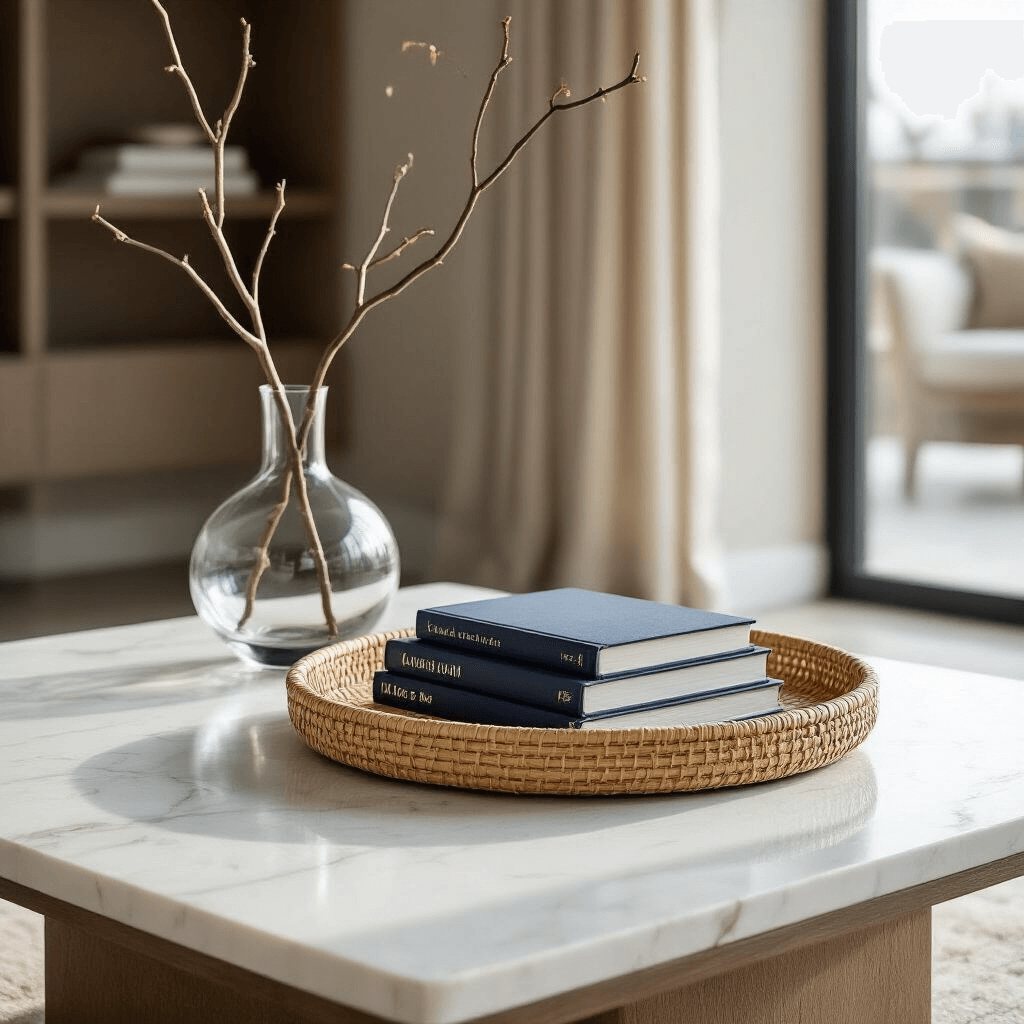
I’m obsessed with round trays on rectangular tables because that circular shape breaks up all the straight lines without fighting them. Mirrored trays add glamour. Woven trays bring warmth. Wooden trays feel grounded and organic. Pick based on the vibe you’re chasing.
Play With Height Like a Stylist
Flat surfaces bore the eye to tears. You need visual peaks and valleys.
The triangle technique:
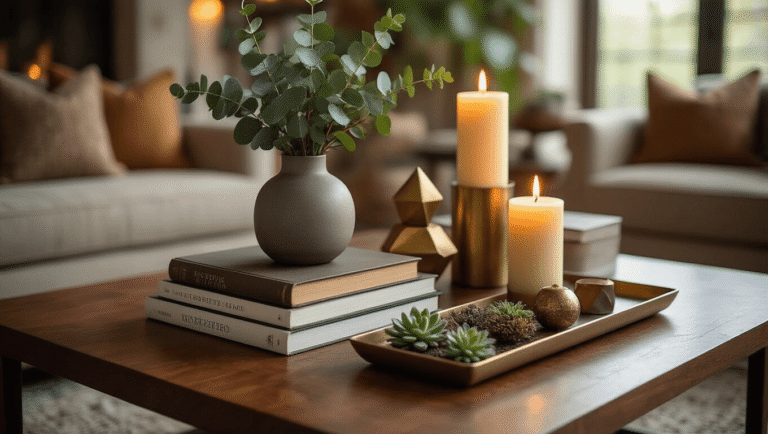
- Place your tallest item (vase, candle, sculpture) at one point
- Add a medium-height piece nearby
- Include something low to complete the triangle
Your eye naturally travels from high to low to medium, creating movement across a static surface.
I keep tall glass vases on hand because they add dramatic height without visual weight.
Height guidelines:
- Tallest items: 12-18 inches for standard coffee tables
- Medium items: 6-10 inches
- Low items: 2-5 inches
Nothing should block sight lines when people are seated. I learned this during a dinner party when my oversized plant became a conversation barrier.
Mix Materials Like You’re Making a Recipe
Single-texture arrangements fall flat. Combine different materials to create depth:
Winning combinations:
- Smooth glass + rough stone
- Warm wood + cool metal
- Soft fabric + hard ceramic
- Matte finish + glossy surface
I always include at least one natural element (wood, stone, plants) to keep things from feeling too manufactured. Decorative bowls in interesting materials become functional catch-alls that earn their spot.
Stack Books With Purpose
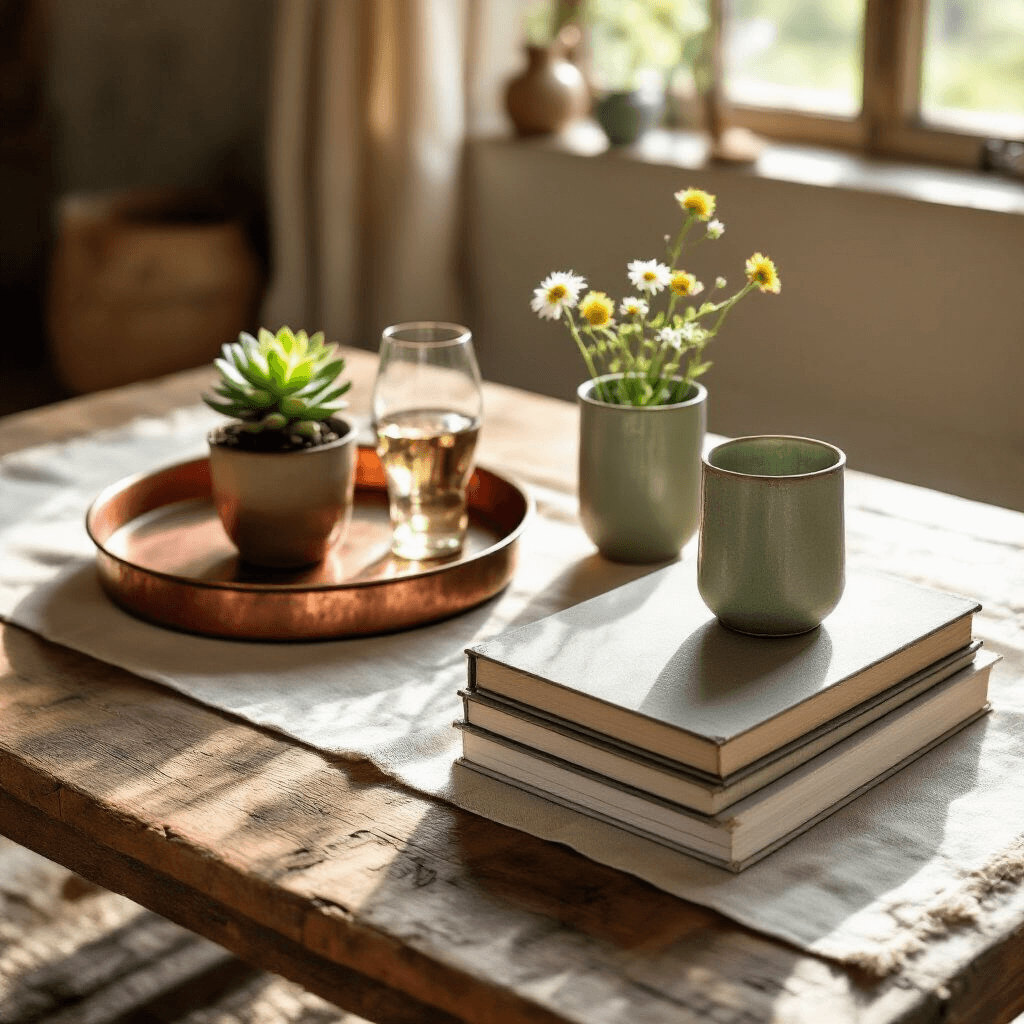
Coffee table books aren’t just for reading. They’re architectural elements.
How to style them right:
- Choose 2-3 large-format books with attractive covers
- Stack them with spines aligned
- Top the stack with a small object (candle, sculpture, small plant)
- Use books to elevate smaller items to better viewing heights
The stack creates an instant pedestal. Remove dust jackets if the covers clash with your color scheme. Or embrace bold covers as your color accent.
I rotate my coffee table books seasonally because it’s the easiest way to refresh the entire look.
Repeat Colors For Cohesion
Your coffee table shouldn’t exist in isolation.
The color echo technique:
- Identify 1-2 dominant colors in your room
- Pull those exact shades onto your coffee table
- Use them in small doses (book spine, vase color, candle holder)
This subtle repetition creates visual flow without screaming “I color-coordinated everything.”
My living room has navy accents, so I keep navy-spined books and a navy ceramic piece on the table. The connection feels intentional but not rigid.
Bring In Something Living
Plants and flowers transform arrangements from styled to alive.
Green options:
- Small potted succulents for low maintenance
- Fresh flowers for special occasions
- Tall branches for dramatic height
- High-quality faux plants if you’re plant-challenged
I keep a rotation of small potted plants that I swap based on season and whim.
Protection matters:
Always use waterproof saucers under plants. Your table’s finish isn’t worth sacrificing for aesthetics.
Balance Pretty With Practical
Your coffee table needs to work, not just pose.
Functional items that look good:
- Decorative boxes (hide remotes and charging cables)
- Beautiful coasters (protect surface while looking intentional)
- Elegant candle lighters (no more ugly plastic ones visible)
- Stylish matches in pretty containers
The goal is seamless integration where practical items enhance rather than detract from your design.
I stopped hiding remotes in drawers once I found decorative storage boxes that actually match my aesthetic.
The Power of Empty Space
This is where most people go wrong. More items doesn’t equal better style.
The removal test:
Once
This post may contain affiliate links. Please see my disclosure policy for details.