Key Info
Contents
Prep time: 30 minutes
Cook time: 15 minutes
Rest time: 30 minutes
Total time: 1 hour 45 minutes
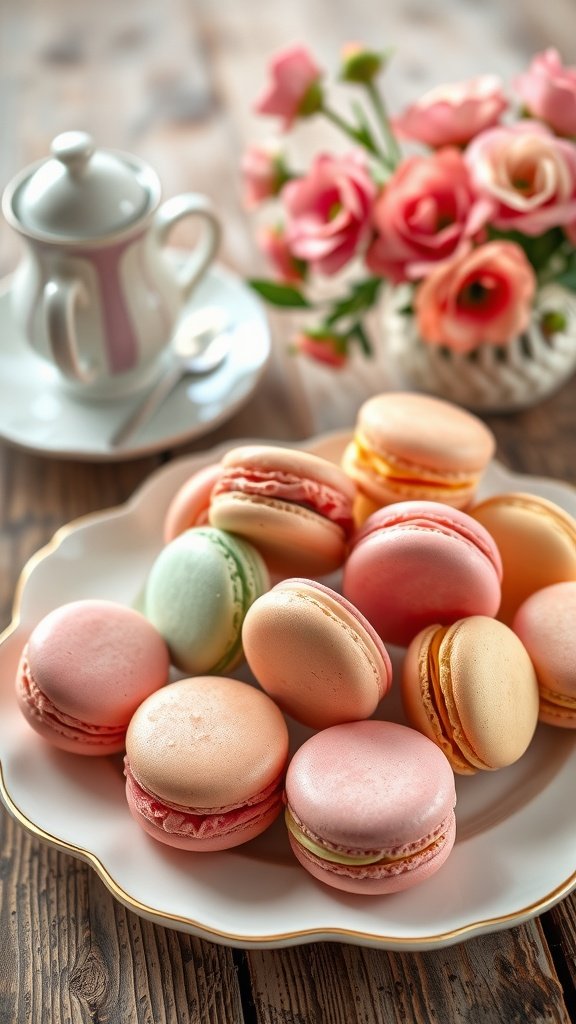
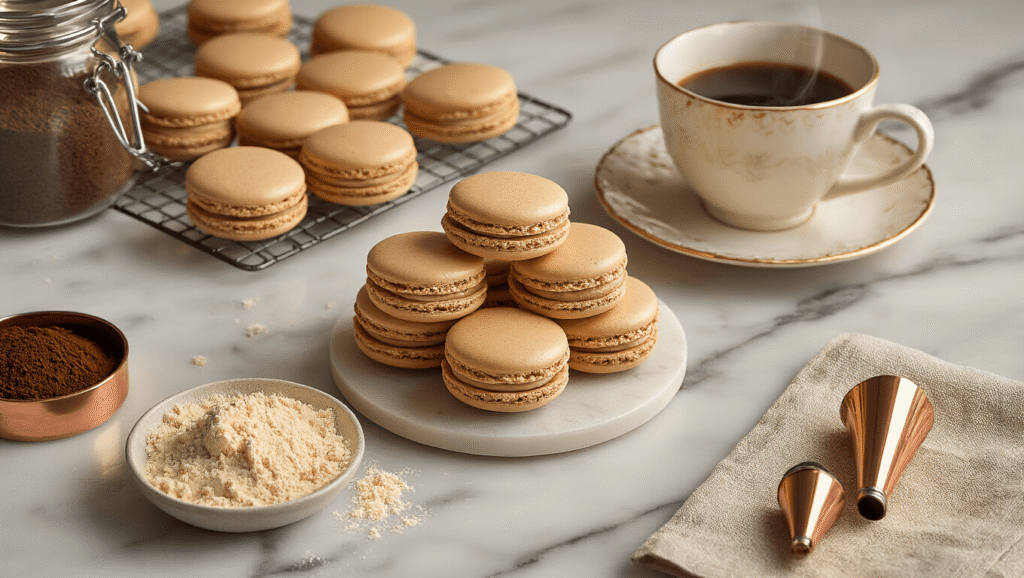
Servings: 24-30 macarons
Difficulty level: Intermediate
Dietary tags: Vegetarian, gluten-free, can be made dairy-free
Equipment Needed
Here’s what you actually need:
- Stand mixer or hand mixer (stand mixer makes life easier)
- Kitchen scale (this is non-negotiable—measuring cups will fail you here)
- Fine-mesh sieve or sifter
- Silicone baking mats (parchment works but silicone gives better results)
- Piping bag with round tip (size #12 works perfectly)
- Oven thermometer (your oven lies—trust me on this)
- Rubber spatula
- Two baking sheets
Simple alternatives: Hand mixer instead of stand mixer (your arm will get tired but it works)
Ziploc bag with corner snipped off instead of piping bag
Ingredients
For the Macaron Shells
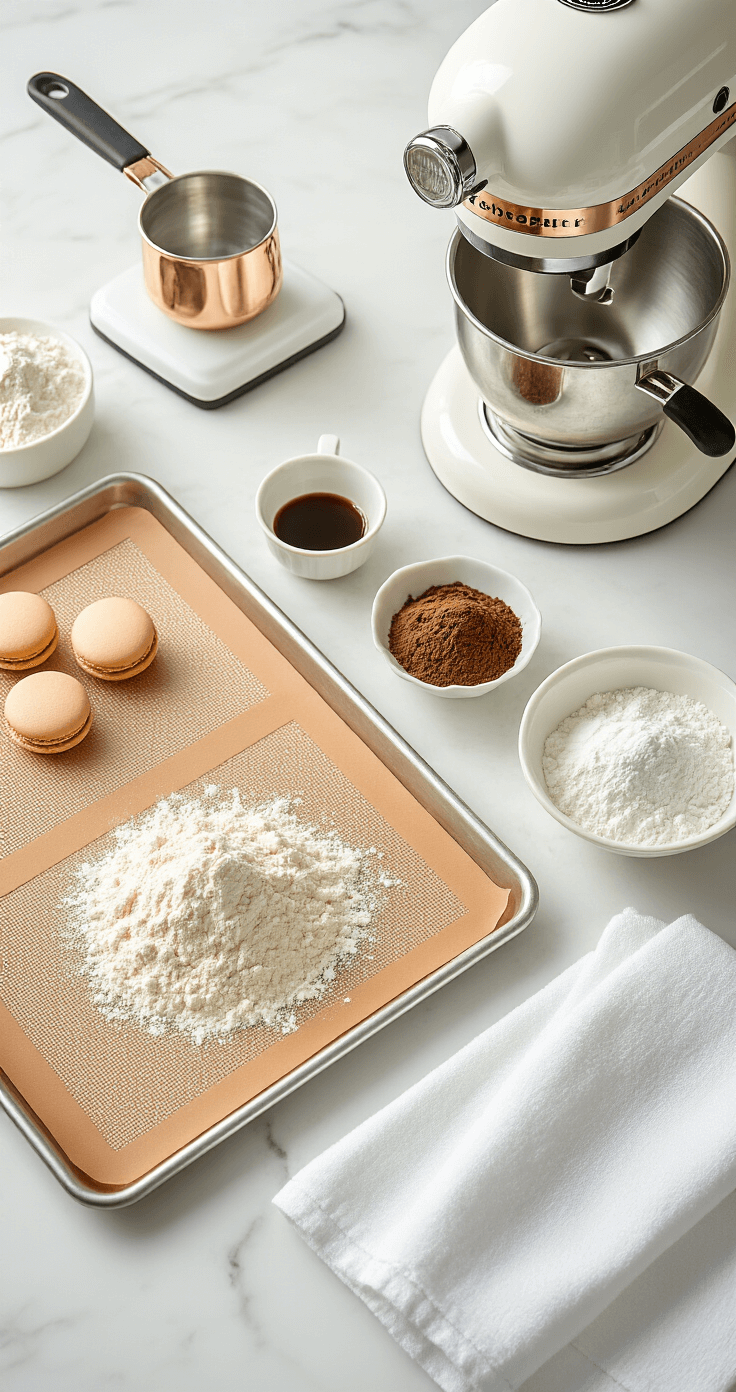
- 120g almond flour (4.2 oz / about 1¼ cups)
- 120g powdered sugar (4.2 oz / about 1 cup)
- 2 tablespoons instant espresso powder
- 90g egg whites (3 oz / about 3 large eggs), aged 24 hours at room temperature
- 100g granulated sugar (3.5 oz / ½ cup)
- ¼ teaspoon cream of tartar
- Pinch of salt
- Brown gel food coloring (optional, for that coffee color)
For the Coffee Buttercream
- 115g unsalted butter (4 oz / ½ cup), softened
- 180g powdered sugar (6.3 oz / 1½ cups)
- 1½ tablespoons instant espresso powder
- 1 tablespoon hot water
- ½ teaspoon vanilla extract
- Pinch of salt
Method
Prepare Your Workspace
- Line two baking sheets with silicone mats or parchment paper.
- Sift almond flour, powdered sugar, and espresso powder together twice—yes, twice, because lumpy macarons are sad macarons.
- Separate your eggs and let those whites sit at room temperature for 24 hours if possible (this makes stronger meringue).
Make the Meringue
- Add egg whites to your stand mixer bowl with cream of tartar and salt.
- Whip on medium speed until the mixture looks foamy and white.
- While mixer runs, slowly add granulated sugar one tablespoon at a time (rushing this step = flat macarons).
- Once all sugar is added, crank speed to high and beat for 6-8 minutes until stiff peaks form—the meringue should cling to the whisk when you lift it.
- Add brown gel coloring if you want that coffee-shop aesthetic (start with a toothpick amount).
The Macaronage (This Makes or Breaks Your Macarons)
- Add half the sifted dry ingredients to the meringue.
- Use your rubber spatula to fold—not stir, fold—cutting down through the center and scraping up the sides.
- Add remaining dry ingredients and continue folding.
- Here’s where it gets critical: keep folding until the batter flows like lava and forms a figure-8 without breaking.
- Stop immediately when you reach this consistency—over-mixing means no feet, under-mixing means cracked tops.
The batter should fall in thick ribbons that disappear back into themselves within 10-15 seconds.
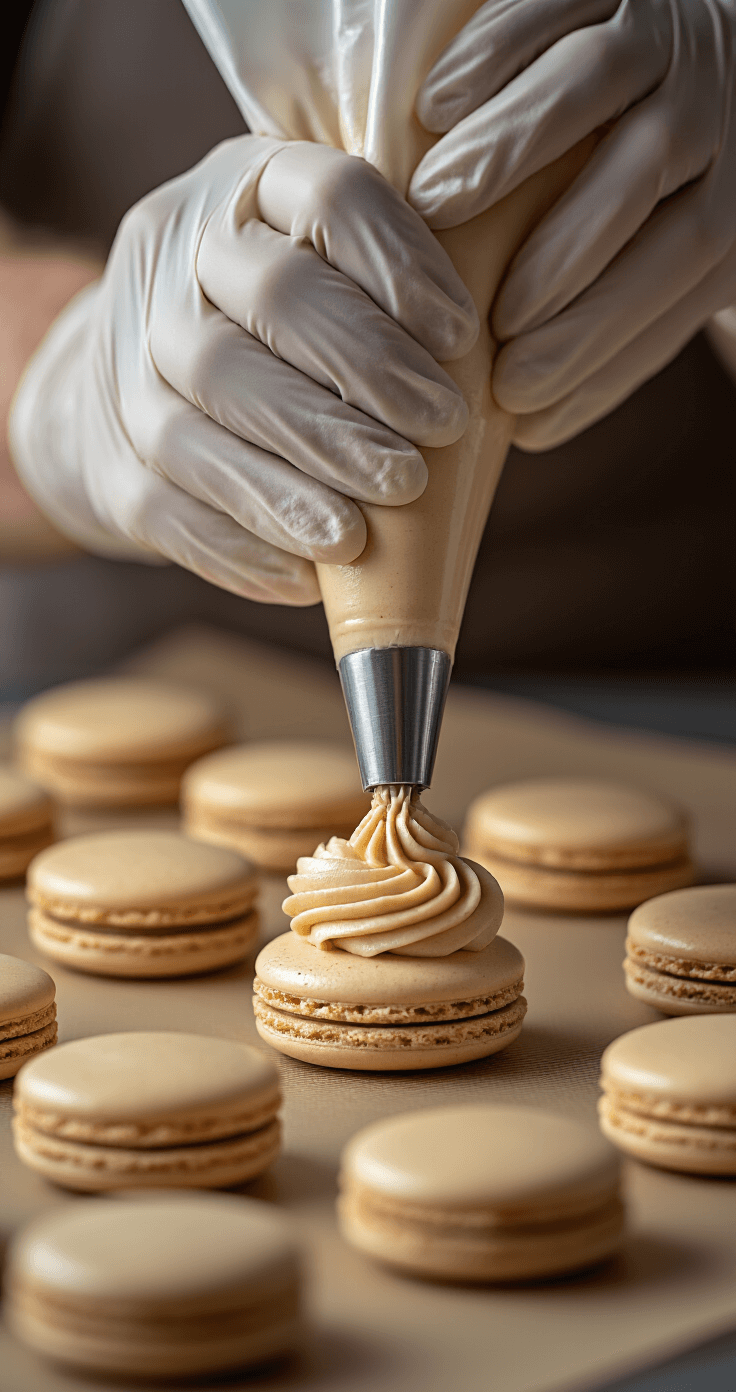
Pipe and Rest
- Transfer batter to piping bag fitted with round tip.
- Hold bag perpendicular to baking sheet and pipe 1.5-inch circles, leaving 2 inches between each.
- Lift bag straight up after piping (this prevents peaks).
- Tap baking sheets firmly on counter 5-6 times to release air bubbles.
- Use a toothpick to pop any visible bubbles.
- Let macarons rest uncovered for 30 minutes (in humid climates, extend to 45-60 minutes).
Touch the surface gently—if it doesn’t stick to your finger, they’re ready to bake.
Bake
- Preheat oven to 300°F (150°C) using your oven thermometer to verify actual temperature.
- Bake for 14-16 minutes, rotating sheet halfway through.
- Macarons are done when they don’t wobble when you gently touch the tops—they should feel firm.
- Let cool completely on baking sheet before attempting to remove (impatience = broken shells).
Make the Buttercream
- Dissolve espresso powder in hot water and let cool.
- Beat softened butter with hand mixer for 5-7 minutes until fluffy and pale.
- Add powdered sugar ½ cup at a time, beating well between additions.
- Pour in cooled espresso mixture, vanilla, and salt.
- Beat on high for 3-4 minutes until light and airy.
If buttercream seems too soft, refrigerate for 10 minutes.
Assemble
- Match macaron shells by size (use the bottoms—they’re flatter).
- Pipe or spread buttercream on flat side of one shell.
- Top with matching shell and press gently until buttercream reaches edges.
- Place assembled macarons in airtight container and refrigerate at least 4 hours (this is called “maturing” and it’s when the magic happens).
Crucial Tips
Age your egg whites. Older whites create more stable meringue—leave them uncovered in the fridge for 24-48 hours before using.
Humidity is your enemy. Don’t attempt macarons on rainy days unless you enjoy disappointment.
The figure-8 test is everything. Under-mixed batter = cracked, lumpy tops. Over-mixed batter = flat cookies with no feet. Perfect batter = smooth tops with frilly feet.
Oven temperature matters more than you think. Most home ovens run 25°F hotter or cooler than displayed—get that thermometer.
<
This post may contain affiliate links. Please see my disclosure policy for details.