Contents
- Siphon Coffee Makers have captured my heart like no other brewing method, and I’m about to share everything you need to know about these mesmerizing contraptions.
- What Exactly Is This Beautiful Beast?
- The Magic Behind the Madness: How Your Siphon Actually Works
- Breaking Down Your Siphon’s Anatomy
- Why I’m Obsessed with Immersion Brewing
- The Flavor Profile That Keeps Me Coming Back
You’ve probably walked past one at a specialty coffee shop and stopped dead in your tracks. The bubbling, the steaming, the theatrical performance happening right before your eyes. Maybe you wondered if it was some kind of chemistry experiment gone rogue.
Trust me, I get it. The first time I saw a siphon coffee maker in action, I thought someone was brewing a potion rather than my morning cup of joe.
What Exactly Is This Beautiful Beast?
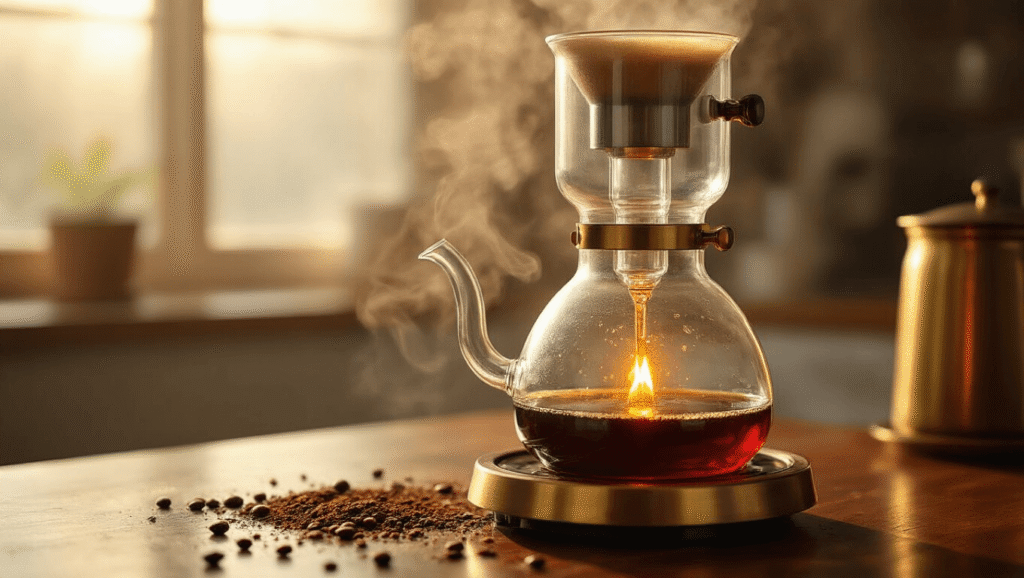
A siphon coffee maker (also called a vacuum pot) is a brewing device that uses vapor pressure and vacuum force to extract coffee through a theatrical two-chamber process.
Think of it as the drama queen of the coffee world. It doesn’t just make coffee – it puts on a show while doing it.
I’ve been brewing with siphons for over five years now, and I still catch myself mesmerized by the process. There’s something almost hypnotic about watching that water dance between chambers.
Here’s what makes it special:
- Uses both pressure and vacuum to brew
- Creates a clean, bright cup of coffee
- Offers complete control over brewing variables
- Provides entertainment value that never gets old

The Magic Behind the Madness: How Your Siphon Actually Works
The siphon operates on the principle of expansion and contraction of water vapor. It’s like watching physics come alive in your kitchen.
Step 1: The Heat-Up
Water heats in the lower chamber, and heat is applied to water in the bottom globe, generating vapor pressure that builds up.
I remember my first attempt – I was so nervous about getting the heat just right. The key is patience. Don’t rush this step, or you’ll end up with a mess instead of coffee.
Step 2: The Great Migration
Water rises to the upper chamber as the pressure forces hot water up through an internal tube into the upper chamber, where ground coffee is added.
This is where the magic happens. You’ll see the water start to bubble up like a mini geyser. It’s the moment I always hold my breath.
Step 3: The Steeping Dance
Immersion brewing begins as the coffee steeps in the hot water using the full immersion method (similar to a French press) for a specific time, typically around 1.5 minutes.
Pro tip: I set a timer every single time. Even after years of doing this, I still get distracted by the spectacle and forget to time it properly.
Step 4: The Grand Finale
Vacuum drawdown occurs when heat is removed, the vapor in the lower chamber stops being produced and condenses back into water, creating a partial vacuum. This pressure difference pulls the brewed coffee back down through a filter into the lower chamber, leaving the grounds behind.
This is the moment that never fails to amaze me. Watching that coffee get sucked down like it’s being pulled by an invisible force – pure poetry.

Breaking Down Your Siphon’s Anatomy
A siphon coffee maker consists of five main parts, and understanding each one is crucial for brewing success.
The Essential Components:
- Lower glass chamber (bulb) – Your coffee’s final destination
- Upper brewing chamber – Where the magic happens
- Internal siphon tube – The highway for your water and coffee
- Filter – Your grounds’ security guard (cloth, paper, or metal options)
- Sealing gasket – The unsung hero that keeps everything tight
- Heat source – Your choice of alcohol burner, butane burner, or halogen light
I’ve tried every type of filter over the years, and honestly, each gives you a slightly different cup. Cloth filters give you the fullest body, while metal filters are easiest to maintain.

Why I’m Obsessed with Immersion Brewing
The siphon uses the immersion brewing method, which differs from percolation methods like pour-overs.
What makes immersion brewing special:
- Complete saturation of coffee grounds
- Even extraction throughout the brewing time
- More control over contact time
- Consistent results once you nail the technique
The grind size is typically medium-coarse, similar to Chemex. I learned this the hard way after ruining several batches with grinds that were too fine.
My grinding guidelines:
- Think sea salt texture
- Avoid powder-fine grinds at all costs
- Consistency matters more than perfection
- Invest in a decent burr grinder – trust me on this one

The Flavor Profile That Keeps Me Coming Back
The brewing produces a clean, balanced cup with bright notes and a syrupy body when executed properly.
I’ll be honest – my first few cups were disasters. Too bitter, too weak, sometimes both simultaneously. But when you get it right, it’s like discovering coffee all over again.
What to expect flavor-wise:
- Brightness – The acidity really shines through
- Clarity – You can taste individual flavor notes
- Body – Heavier than pour-over, lighter than French press
- Complexity – The immersion method brings out subtle flavors

Getting Started: Your First Siph
This post may contain affiliate links. Please see my disclosure policy for details.
This post may contain affiliate links. Please see my disclosure policy for details.